
Dillygence
Industrial scheduling: the end of manual carbon piloting
Industrial scheduling: visualize eco-performance gains, move beyond guesswork, and achieve your Net-Zero goals through data.
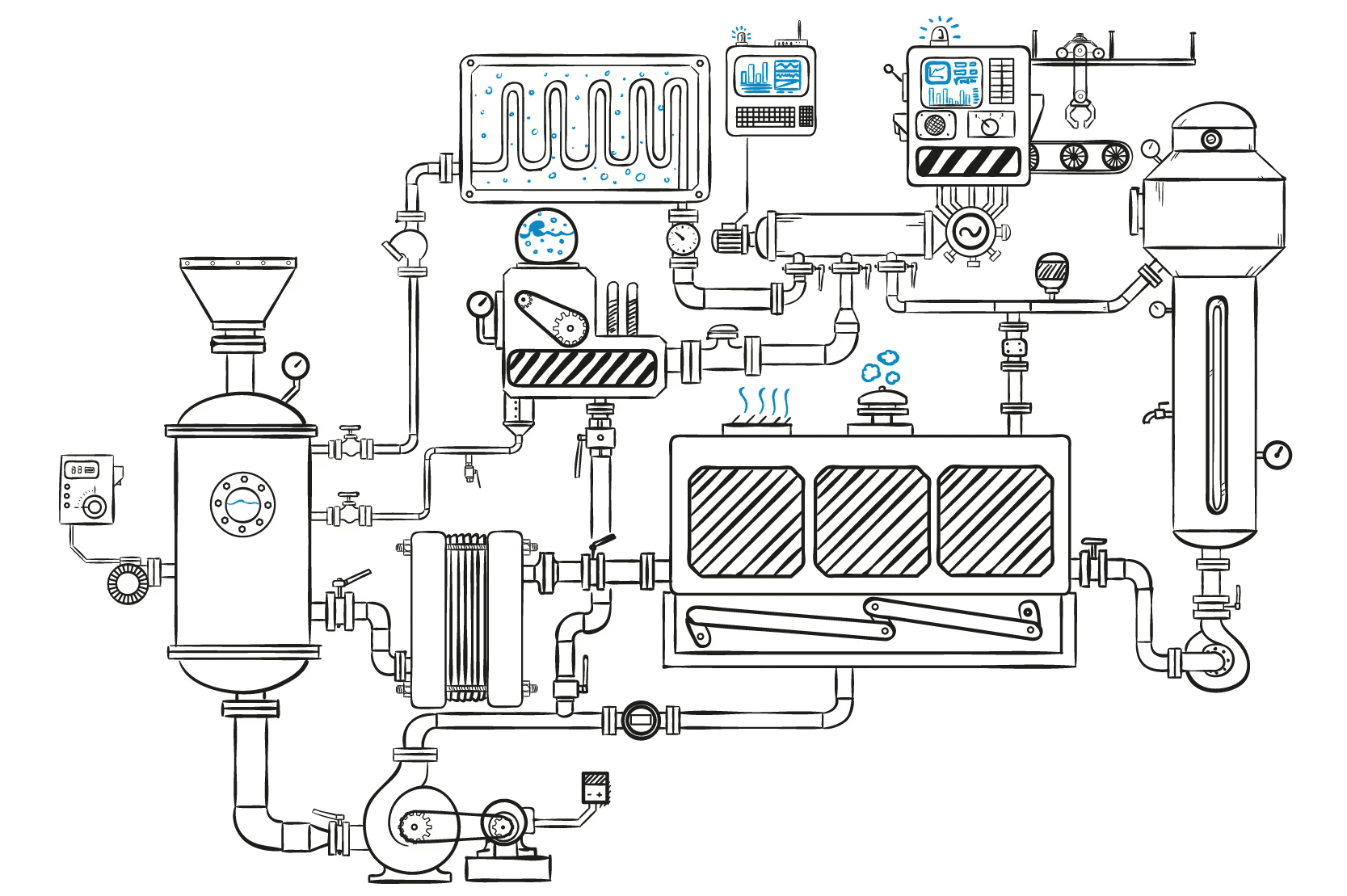
Industrial scheduling: a lever for performance transformation and sustainability
Industrial scheduling is gradually becoming a decisive factor between operational inertia and eco-efficient progress. Achieving ambitious decarbonisation goals today relies on quantitative and structured optimisation, implemented on a large scale. Predictive software platforms, integrated across the entire industrial ecosystem, now make Net-Zero ambitions achievable. This transformation reshapes the very definition of performance: algorithmic management is the new standard, freeing people from managing complexity so they can focus on strategic decision-making.
Contrary to comforting rhetoric, reality calls for a methodological shift: eco-performance is not a matter of tools, but of the ability to model, correlate and optimise thousands of variables in real time. Faced with this exponential complexity, artificial intelligence, combined with total connectivity of information systems (ERP, MES, IoT), provides the responsiveness needed to make carbon reduction the new industrial standard. The question is no longer “should we digitise?”, but “how do we make data the engine of sustainable transformation?” Industrial scheduling enables this transition to be structured.
The limits of manual solutions
Why Excel can no longer handle the complex variables linked to the carbon footprint
Manual management has failed to cope with the complexity of industrial decarbonisation. The spreadsheet, once the king of production management, is now unable to handle the thousands of factors that influence the carbon footprint of a modern plant. No spreadsheet can correlate the impact of the local energy mix, real-time weather changes, machine availability, series sequencing or skills allocation on the lines.
As a result, Excel locks organisations into energy-intensive patterns: it imposes static assumptions, ignores threshold effects and offers no responsiveness to contingencies. As soon as the number of adjustable parameters exceeds ten, human cognition hits its limits: it is impossible to test all combinations.
In this context, continuing to entrust carbon management to "homemade" solutions amounts to accepting chronic under-optimisation: data is neither connected, nor updated, nor used to its full potential. The factory is trapped in routines that, while once effective, become bottlenecks for environmental performance. Industrial scheduling overcomes these limitations by integrating all key variables into a single, connected and scalable model.
The challenges of traditional approaches in the face of environmental and industrial requirements
As regulatory pressure and market sensitivity intensify, traditional approaches reveal their obsolescence. Industrial managers must deal with multiple demands: reducing scope 1 and 2, ensuring traceability of flows, securing production flexibility, all while maintaining profitability.
But traditional tools fail to cross-reference these constraints within a global model. Management is reduced to successive corrections after the fact, with no predictive vision or ability to simulate the impact of alternative scenarios. This methodological inertia leads to hidden costs: excessive energy consumption, surplus stocks, suboptimal configurations.
On the other hand, algorithmic digitalisation offers a structural solution to this deadlock. It enables continuous data integration, real-time simulation of the impact of each decision, anticipation of breaking points and adjustment of the production plan before waste or extra costs occur. Transitioning to intelligent industrial scheduling has become a must for any company aiming for environmental excellence.
Algorithms for optimised production
Automating industrial scheduling: optimising sequences to accelerate decarbonisation
One of the levers of industrial decarbonisation is the optimisation of production sequences, particularly by reducing "set-ups". Each series change involves a transitional phase: heating up, line purging, etc.
Human intervention cannot identify the best possible sequence of batches to minimise these losses. The reason is simple: the number of combinations explodes as soon as the product portfolio or order variability increases. Algorithms, capable of evaluating millions of scenarios in seconds, can reveal the optimal sequence.
Unlike static routines, AI continuously analyses machine status and quality constraints. It identifies situations where intelligent batch grouping significantly reduces transition phases, thereby limiting consumption and associated emissions. As a result, production follows a path of sobriety, with no compromise on deadlines. Automated industrial scheduling becomes a decisive tool for accelerating decarbonisation while securing production rates.
Defining the best sequence with advanced computing power
The quest for the most efficient production sequence is not a matter of intuition, but of computing power. Every plant is a complex ecosystem, where the slightest change in the schedule can have cascading effects on all KPIs.
Algorithmic optimisation, based on stochastic models, makes it possible to test all permutations in real time, integrating both physical constraints and environmental objectives.
From this angle, digitising industrial scheduling is a revolution in how industrial choices are made. Each scheduling change is simulated, scored, then validated based on its carbon impact.
Towards predictive process visualisation
From historical analysis to emissions forecasting: reducing waste
Industrial Business Intelligence must now embrace the predictive field. It’s no longer a question of recording what has been emitted, but of anticipating what will be produced based on the schedule.
Thanks to the massive collection of data from MES and ERP systems, it becomes possible to project future emissions in real time, alert on potential deviations, and adjust the production plan before waste occurs. Visualisation is no longer a mirror of the past, but a predictive cockpit guiding decisions. Predictive industrial scheduling has become the key to anticipating and correcting discrepancies before they become structural.
Smart dashboards to adjust operations in real time
The move to smart visualisation requires tools capable of synthesising operational complexity into clear, actionable indicators. The best eco-performance software integrates dynamic dashboards, fed in real time by industrial flows.
In this perspective, the industrial manager finally has an operational cockpit: they can instantly visualise deviations, simulate the impact of a schedule change, and pilot the necessary adjustments to ensure the Net-Zero trajectory. As a result, reaction time collapses and environmental performance becomes part of the industrial routine. Industrial scheduling, combined with these decision-making tools, enables proactive operations management and measurable waste reduction.
ERP and MES connectivity: a pillar of eco-performance
Linking industrial data for fast and sustainable decisions
One of the main prerequisites for digital transformation is the ability to connect all parts of the industrial information system. The interface between ERP and MES forms the basis of an uninterrupted data flow.
Unlike siloed environments, data integration enables each production launch to be arbitrated by instantly assessing its carbon impact. This digital continuity transforms the plant into a nervous system, where every piece of information circulates in real time. Industrial scheduling, interfaced with all systems, becomes the conductor ensuring fluidity and responsiveness.
Developing digital continuity to arbitrate each launch according to carbon impact
Digital continuity requires the creation of an operational model capable of arbitrating each production launch based on its immediate impact.
Thanks to advanced interfacing between ERP, MES and simulation tools, each decision is based on a detailed modelling of resources. It becomes possible to compare, in real time, several launch scenarios: to prioritise an urgent low-footprint order or delay an energy-intensive batch. Industrial scheduling, enhanced by this digital continuity, gives the industrial decision-maker the ability to arbitrate each launch in favour of overall performance.
Choosing software suited to eco-performance
Computing power and IoT connectivity as prerequisites
Selecting a next-generation scheduling tool is not a question of brand, but of the ability to address increasing complexity. The first requirement is computing power: a robust algorithmic engine can process all possible combinations in real time.
Unlike solutions limited to reporting, eco-performance software must rely on native IoT connectivity. This architecture ensures continuous data updates, a prerequisite for steering competitiveness. Industrial scheduling connected to IoT breaks down information silos and speeds up decision-making on the shop floor.
Ease of use and model flexibility: fostering efficiency and adoption
The success of a digitisation project depends on the ability to involve all teams in the transformation, from operator to site manager. Industrial scheduling software must offer an intuitive user interface, customisable dashboards, and flexibility to adapt models to each site's reality, facilitating ownership and operational efficiency.
Moving from reporting to an operational approach to drive sustainable competitiveness
The qualitative leap lies in the ability to move from an after-the-fact reporting logic to an operational approach, focused on action and results. Industrial managers need tools that prescribe, simulate and optimise every production sequence.
By adopting these solutions, manufacturers can turn regulatory obligations into a competitive advantage. The era of manual trial and error is over: eco-performance is becoming a new tool for industrial competitiveness. Industrial scheduling, at the heart of this approach, is establishing itself as the lever for sustainable and profitable transformation.
To find out how Dillygence supports manufacturers in this transformation, contact our experts!


