Industrial layout: eliminating losses related to waste
Industrial layout: eliminating losses related to waste
Industrial layout: transform your production and generate profit instead of waste.
Industrial layout: transform your production and generate profit instead of waste.
Feb 10, 2026
Dillygence
How an industrial SME turned a hidden loss of several hundred euros per year into a performance lever thanks to One Piece Flow.
Reading time: 8 minutes
Client: Leading player in the Visual Identity & Communication sector
Challenge: Industrial relocation and restructuring of flows
Dillygence Solution: Factory Roadmap
Introduction: The paradox of industrial expansion
For many industrial SMEs, opening a new production site feels like an achievement. Expansion is celebrated, growth, walls moving to welcome more activity. Yet, this pivotal stage often hides obstacles to performance and profitability.
The reason? Space can become an unexpected adversary.
In a cramped workshop, constraints impose rational choices. But adding 500 sqm to a poorly designed system disperses resources. Journeys lengthen, stocks spread out, and every communication error results in unnecessary kilometers covered by staff.
This is precisely the scenario our client, a leading French SME in visual identity, wanted to avoid. Facing the deadline of moving to a 550 sqm workshop, management chose not just to relocate equipment but to completely rethink its industrial organization.
Discover how this company moved from a fragmented artisanal operation to a "One Piece Flow" inspired by Industry 4.0.
I. Industrial maturity diagnosis: revealing hidden flaws in productive layout
Before our team was called in, the company had strong commercial performance. Yet, industrially, it suffered structural dysfunctions holding back its competitiveness.
The initial diagnosis revealed a classic but costly situation. The old workshop had grown organically, adding machines as contracts arrived, with no overall vision.
1. The "Spaghetti Plate" syndrome
By tracing the physical product flows, we revealed a discontinuous flow. What does this mean? Parts made endless round trips, crossed other flows, returned for rework, and stagnated in improvised buffer zones.
2. The financial impact of dispersion
This logistical chaos went beyond aesthetics: it severely impacted finances and slowed daily activities. When aiming for an optimized industrial layout, every unnecessary movement of a part or employee translates into a discreet but tangible loss, directly affecting financial results. Behind a disorganized workshop, hidden costs and multiple inefficiencies accumulate, often unnoticed by managers, but hampering profitability.
Over-handling: Every time an operator moves a part without transforming it, it’s a pure loss. These unnecessary movements increase team fatigue, dilute productive energy, and create hidden costs in maintenance and wear of handling equipment.
Degraded quality: The more a part is moved and stored, the higher the risk of shock or error. Excess handling weakens products, multiplies control points, slows overall flow, and creates stress for operators.
Estimated non-quality costs linked to this organization amounted to several hundred thousand euros a year. For an SME of this size, that's equal to several months of net margin evaporating in workshop dysfunctions. These losses, often invisible on dashboards, result in reduced competitiveness, limited investment capacity, and a brake on innovation.
Mission objective: Use the move to eradicate these hidden costs, reduce Lead Time and waste, and design a "Target Factory" able to absorb future growth. Industrial layout must become a lever for global performance: align space, flows, and tools with company strategy, while creating an environment conducive to continuous improvement, skill development, and operational sustainability.
II. Industrial layout: Dillygence methodology to transform flows through data
Dillygence's response went beyond a simple 2D layout plan. We deployed our Factory Roadmap methodology, merging flow engineering (Lean) with data (Data).
The project revolved around the radical transformation of the Layout (factory arrangement).
The "Tabula Rasa" approach
Industrial layout is not just a sum of preferences or a copy of existing patterns. These classic reflexes often lead to fixed zones and limits in overall performance. At Dillygence, the approach is based on objective flow analysis and seeking the most efficient configuration, considering flexibility and future evolution.
The project was to structure the workshop to ensure continuity of operations, limit disruptions, and facilitate gap identification. This organization enables shorter cycles, smoother management, and rapid adaptation to production needs.
Everything was designed to promote synchronized flow, where work-in-progress remains under control, traceability is strengthened, and bottlenecks are quickly detected. This logic supports team engagement, quality control, and performance per square meter of industrial layout.
III. The Technical Solution: Densification
To ensure continuous flow, the workshop configuration was completely overhauled: every aspect of movement, physical locations, and functional densification was analyzed. Industrial layout goes beyond just a layout diagram or moving machines; it is a strategic approach, decisive for long-term operational performance. Every layout decision was made to minimize waste, shorten throughput times, and boost the factory's adaptability to growth. The goal: turn space into a true engine of productivity, quality, and efficiency, far beyond a simple framework for activity.
1. Flow model
The target factory was designed with an innovative configuration, favoring proximity of strategic stations and minimizing unnecessary movements. This setup promotes team responsiveness, effective supervision, and ramp-up without disorder. By centralizing critical resources, this industrial layout optimizes operational management, eases maintenance, and ensures clear oversight of the entire production process.
2. Single Entry/Exit strategy
In the final design, a strict rule was applied: only one material entry and exit for the main production area. This organization greatly reduces the risk of flow crossing and logistical errors. The flow then follows a unidirectional, sequential, and continuous path. Every material goes through all stages without interruption, following aligned technical islands, and emerges as a finished product. This laminar flow strengthens traceability, simplifies quality control, and quickly identifies any anomaly. This approach consolidates the robustness of industrial layout and deadline management.
3. Production area densification
To free up useful space, machines were brought closer together and production concentrated in a specific area of the workshop. This densification optimizes industrial layout: it reduces transfer times, limits floor clutter, frees space for ancillary functions, and prepares the factory for growth without heavy reorganization.
IV. Digital and Human Aspect: Towards Industry 4.0
Drawing the outlines of a high-performing workshop is not enough: it must be managed with precision. This is where our expertise in Manufacturing Intelligence comes into play. This relocation project was the perfect opportunity to embed digitalization at the heart of production management.
Paperless, data-driven
Previously, operational monitoring lacked reliability.
"Zero paper" tablets: Finishing teams now use tablets to enter data in real time, reducing errors and administrative workload.
Digital display of indicators: Dedicated screens show performance indicators in real time. KPIs are accessible to all, enabling increased responsiveness and transparent management.
Emergence of a new management
Technology is not meant to replace humans, but to amplify their impact. We supported the company in evolving its management, fostering an organization that values flow fluidity and team versatility.
This new dynamic ensures alignment between industrial strategy and daily operations, while strengthening employee engagement in industrial layout performance.
V. Results: A quantified metamorphosis
After the move and implementation of the new organization, measured results validate the scientific approach to industrial layout.
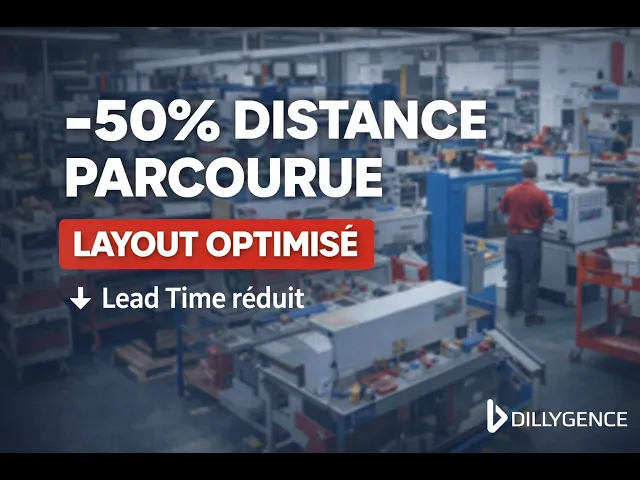
Distance traveled halved
This is the most spectacular indicator of reduced hardship and waste.
45% optimization of useful space
By densifying production on the right side of the workshop, we maximized productive space to 45%, versus 33% previously.
Why is this important? Because it means the company has optimized its footprint, leaving room for future growth.
Impact on Quality and Costs
The implementation of One Piece Flow now enables reduced Lead Time and better defect detection.
In the old system, errors could accumulate. Today, responsiveness is immediate, which significantly reduces defect-related costs and professionalizes production.
VI. Client Testimonial
Let’s give the floor to the General Management of this SME, who best sums up the impact of this cultural and spatial transformation:
"Facing the relocation of our workshop, we absolutely had to innovate. The initial flow, disorganized and discontinuous, created too much waste and stress. The team designed a clear, laminar One Piece Flow layout, halving the distance traveled by materials. By integrating Team Leader roles and visual management, we target 'zero defect' and better traceability, crucial for our growth and the well-being of our 50 employees."
— General Management, Visual Identity sector
Conclusion: More than a move, a rebirth
This client case demonstrates a fundamental truth for every manufacturer: performance does not reside in machines, but in what happens between the machines.
By daring to question assumptions and relying on Dillygence's Factory Roadmap, this company turned a logistical constraint (the move) into a durable competitive advantage. Today it has an agile, digitalized, and economical production tool, ready to meet the challenges of the coming decade.
Key takeaways for your own factory:
Never move your problems with your machines.
Empty space is expensive: optimize your productive density.
Piece-by-piece flow (One Piece Flow) is the best antidote to non-quality costs.
How an industrial SME turned a hidden loss of several hundred euros per year into a performance lever thanks to One Piece Flow.
Reading time: 8 minutes
Client: Leading player in the Visual Identity & Communication sector
Challenge: Industrial relocation and restructuring of flows
Dillygence Solution: Factory Roadmap
Introduction: The paradox of industrial expansion
For many industrial SMEs, opening a new production site feels like an achievement. Expansion is celebrated, growth, walls moving to welcome more activity. Yet, this pivotal stage often hides obstacles to performance and profitability.
The reason? Space can become an unexpected adversary.
In a cramped workshop, constraints impose rational choices. But adding 500 sqm to a poorly designed system disperses resources. Journeys lengthen, stocks spread out, and every communication error results in unnecessary kilometers covered by staff.
This is precisely the scenario our client, a leading French SME in visual identity, wanted to avoid. Facing the deadline of moving to a 550 sqm workshop, management chose not just to relocate equipment but to completely rethink its industrial organization.
Discover how this company moved from a fragmented artisanal operation to a "One Piece Flow" inspired by Industry 4.0.
I. Industrial maturity diagnosis: revealing hidden flaws in productive layout
Before our team was called in, the company had strong commercial performance. Yet, industrially, it suffered structural dysfunctions holding back its competitiveness.
The initial diagnosis revealed a classic but costly situation. The old workshop had grown organically, adding machines as contracts arrived, with no overall vision.
1. The "Spaghetti Plate" syndrome
By tracing the physical product flows, we revealed a discontinuous flow. What does this mean? Parts made endless round trips, crossed other flows, returned for rework, and stagnated in improvised buffer zones.
2. The financial impact of dispersion
This logistical chaos went beyond aesthetics: it severely impacted finances and slowed daily activities. When aiming for an optimized industrial layout, every unnecessary movement of a part or employee translates into a discreet but tangible loss, directly affecting financial results. Behind a disorganized workshop, hidden costs and multiple inefficiencies accumulate, often unnoticed by managers, but hampering profitability.
Over-handling: Every time an operator moves a part without transforming it, it’s a pure loss. These unnecessary movements increase team fatigue, dilute productive energy, and create hidden costs in maintenance and wear of handling equipment.
Degraded quality: The more a part is moved and stored, the higher the risk of shock or error. Excess handling weakens products, multiplies control points, slows overall flow, and creates stress for operators.
Estimated non-quality costs linked to this organization amounted to several hundred thousand euros a year. For an SME of this size, that's equal to several months of net margin evaporating in workshop dysfunctions. These losses, often invisible on dashboards, result in reduced competitiveness, limited investment capacity, and a brake on innovation.
Mission objective: Use the move to eradicate these hidden costs, reduce Lead Time and waste, and design a "Target Factory" able to absorb future growth. Industrial layout must become a lever for global performance: align space, flows, and tools with company strategy, while creating an environment conducive to continuous improvement, skill development, and operational sustainability.
II. Industrial layout: Dillygence methodology to transform flows through data
Dillygence's response went beyond a simple 2D layout plan. We deployed our Factory Roadmap methodology, merging flow engineering (Lean) with data (Data).
The project revolved around the radical transformation of the Layout (factory arrangement).
The "Tabula Rasa" approach
Industrial layout is not just a sum of preferences or a copy of existing patterns. These classic reflexes often lead to fixed zones and limits in overall performance. At Dillygence, the approach is based on objective flow analysis and seeking the most efficient configuration, considering flexibility and future evolution.
The project was to structure the workshop to ensure continuity of operations, limit disruptions, and facilitate gap identification. This organization enables shorter cycles, smoother management, and rapid adaptation to production needs.
Everything was designed to promote synchronized flow, where work-in-progress remains under control, traceability is strengthened, and bottlenecks are quickly detected. This logic supports team engagement, quality control, and performance per square meter of industrial layout.
III. The Technical Solution: Densification
To ensure continuous flow, the workshop configuration was completely overhauled: every aspect of movement, physical locations, and functional densification was analyzed. Industrial layout goes beyond just a layout diagram or moving machines; it is a strategic approach, decisive for long-term operational performance. Every layout decision was made to minimize waste, shorten throughput times, and boost the factory's adaptability to growth. The goal: turn space into a true engine of productivity, quality, and efficiency, far beyond a simple framework for activity.
1. Flow model
The target factory was designed with an innovative configuration, favoring proximity of strategic stations and minimizing unnecessary movements. This setup promotes team responsiveness, effective supervision, and ramp-up without disorder. By centralizing critical resources, this industrial layout optimizes operational management, eases maintenance, and ensures clear oversight of the entire production process.
2. Single Entry/Exit strategy
In the final design, a strict rule was applied: only one material entry and exit for the main production area. This organization greatly reduces the risk of flow crossing and logistical errors. The flow then follows a unidirectional, sequential, and continuous path. Every material goes through all stages without interruption, following aligned technical islands, and emerges as a finished product. This laminar flow strengthens traceability, simplifies quality control, and quickly identifies any anomaly. This approach consolidates the robustness of industrial layout and deadline management.
3. Production area densification
To free up useful space, machines were brought closer together and production concentrated in a specific area of the workshop. This densification optimizes industrial layout: it reduces transfer times, limits floor clutter, frees space for ancillary functions, and prepares the factory for growth without heavy reorganization.
IV. Digital and Human Aspect: Towards Industry 4.0
Drawing the outlines of a high-performing workshop is not enough: it must be managed with precision. This is where our expertise in Manufacturing Intelligence comes into play. This relocation project was the perfect opportunity to embed digitalization at the heart of production management.
Paperless, data-driven
Previously, operational monitoring lacked reliability.
"Zero paper" tablets: Finishing teams now use tablets to enter data in real time, reducing errors and administrative workload.
Digital display of indicators: Dedicated screens show performance indicators in real time. KPIs are accessible to all, enabling increased responsiveness and transparent management.
Emergence of a new management
Technology is not meant to replace humans, but to amplify their impact. We supported the company in evolving its management, fostering an organization that values flow fluidity and team versatility.
This new dynamic ensures alignment between industrial strategy and daily operations, while strengthening employee engagement in industrial layout performance.
V. Results: A quantified metamorphosis
After the move and implementation of the new organization, measured results validate the scientific approach to industrial layout.
Distance traveled halved
This is the most spectacular indicator of reduced hardship and waste.
45% optimization of useful space
By densifying production on the right side of the workshop, we maximized productive space to 45%, versus 33% previously.
Why is this important? Because it means the company has optimized its footprint, leaving room for future growth.
Impact on Quality and Costs
The implementation of One Piece Flow now enables reduced Lead Time and better defect detection.
In the old system, errors could accumulate. Today, responsiveness is immediate, which significantly reduces defect-related costs and professionalizes production.
VI. Client Testimonial
Let’s give the floor to the General Management of this SME, who best sums up the impact of this cultural and spatial transformation:
"Facing the relocation of our workshop, we absolutely had to innovate. The initial flow, disorganized and discontinuous, created too much waste and stress. The team designed a clear, laminar One Piece Flow layout, halving the distance traveled by materials. By integrating Team Leader roles and visual management, we target 'zero defect' and better traceability, crucial for our growth and the well-being of our 50 employees."
— General Management, Visual Identity sector
Conclusion: More than a move, a rebirth
This client case demonstrates a fundamental truth for every manufacturer: performance does not reside in machines, but in what happens between the machines.
By daring to question assumptions and relying on Dillygence's Factory Roadmap, this company turned a logistical constraint (the move) into a durable competitive advantage. Today it has an agile, digitalized, and economical production tool, ready to meet the challenges of the coming decade.
Key takeaways for your own factory:
Never move your problems with your machines.
Empty space is expensive: optimize your productive density.
Piece-by-piece flow (One Piece Flow) is the best antidote to non-quality costs.