#IA #IntelligenceArtificielle #SupplyChain #GestionDeLaChaîneDapprovisionnement #Logistique #Optimisation #Prédiction #ApprentissageAutomatique #LLM #ModèleDeLangueDeGrandeTaille #IAGénérative #AgentsIA #Digitalisation #PME #ERP #PerformanceIndustrielle #Dillygence #DispoX #Innovation #Technologie
IA et gestion de la chaîne d'approvisionnement

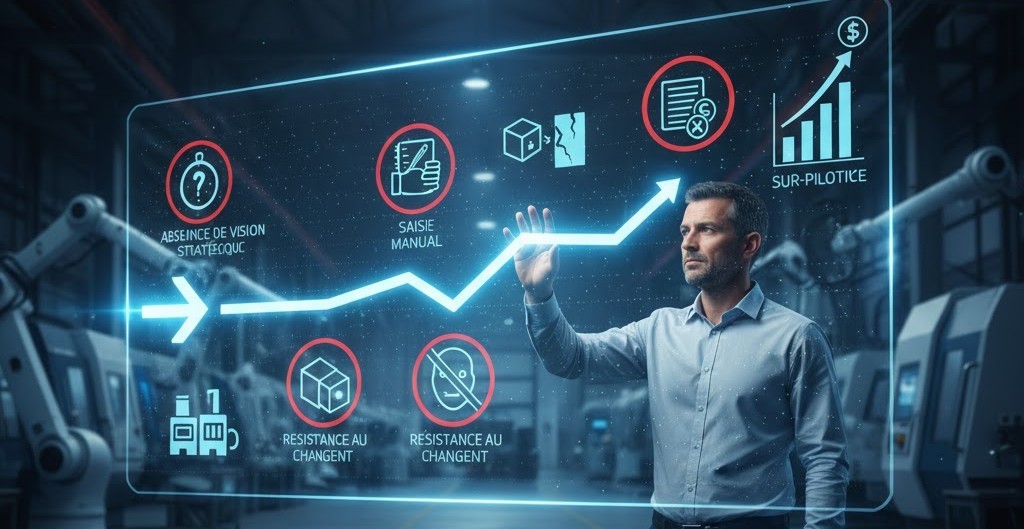
Having recently accompanied various SMEs in choosing their ERP, I was disappointed to find that the Business Intelligence solutions integrated with ERPs still require mastering SQL to create queries and exploit data. In short, unless one undergoes SQL training, SME leaders (or some of their collaborators) do not have direct access to their company's data, which constitutes a barrier to understanding their activity, opportunities, and trends... elements that are nevertheless essential for the operational and strategic management of their companies in a context of digital transformation and increased competitiveness in the supply chain.
In the case of Open Source ERPs, a palliative solution facilitates access to data: it is possible to ask a LLM (Large Language Model) such as ChatGPT to generate the desired SQL query from a natural language inquiry. Even before LLMs are directly integrated into ERPs, this approach already automates complex tasks and democratizes the exploitation of big data in business. LLMs thus become co-pilots and digital assistants capable of helping logistics managers or supply chain managers to more effectively manage their logistics flows, supplies, and warehouse management.
But more generally, what about artificial intelligence in managing the supply chain? The excesses of the use of the term AI and the associated media hype create a fog around this concept and cast doubt on the reality of its effective implementation. Yet, AI - whether it involves machine learning, deep learning, predictive analytics, or digital twins - is gradually establishing itself in inventory management, logistics planning, traceability, and end-to-end visibility, all the way to logistics distribution and international logistics.
First of all, AI is capable of optimizing, predicting, classifying, or generating. Regarding optimization, AI essentially relies on operational research algorithms that have existed for decades. This is the only discipline of AI that does not require learning before using these algorithms. The most classic use involves logistics optimization, particularly delivery route optimization, the accuracy of which has improved over the past 10 years by considering speed data by time slots. Other constraint-based optimization algorithms, such as those used for production scheduling, allow for optimizing production flows, planning, and improving the management of physical flows while reducing costs. These techniques have become essential in large distribution logistics or industrial logistics projects, where supply chain managers must ensure the reliability and resilience of processes.
Regarding prediction, there is an increasing use of Machine Learning. This allows for considering various exogenous variables to improve the quality of demand forecasts, shipments, or supplier performance. Although forecasting methods have existed for decades - exponential smoothing was defined by Robert G. Brown as early as the 1950s - the enhancement of prediction accuracy, particularly through assessing the impacts of exogenous factors, is today one of the great strengths of AI. With open source libraries like Prophet from Meta, it becomes possible in a few weeks to implement models capable of anticipating stock outages, simulating scenarios, or assessing supplier reliability. These solutions enable the automation of analyses that once required months of expertise and configuration. They thus transform the management of supplies, handling, replenishment, and logistics organization within the company.
But the real revolution of AI is linked to generative artificial intelligence, which is very recent - ChatGPT 3 dates only from 2022 - and presents multiple use cases in the supply chain. At Renault, for example, a solution based on knowledge of the supplier site network from rank 1 to n, combined with a scan of press articles and other data from the Internet of Things (IoT), enables real-time identification of events disrupting production, such as a strike or a logistics blockage. This anticipation - a true insight - allows for quick decision-making to reduce risk, optimize delivery times, and avoid operational underperformance. In this context, AI becomes a powerful lever for distribution logistics, road transport, or even the management of logistics operations in complex contexts like international trade.
By leveraging generative AI and LLMs, the current revolution consists of creating AI agents capable of autonomously answering complex questions and actively assisting supply chain managers. These AI agents can:
Understand a natural language instruction and automate it,
Read and analyze documents and data in real-time,
Plan the execution of a complex task by breaking it down into elementary tasks,
Interact with warehouse management (WMS), production, or transport and logistics software,
Simulate scenarios (what if) via digital twins and propose alternatives,
Qualitatively and quantitatively evaluate different supply scenarios, carriers, or regulatory compliance.
These advances allow, for example, to query an agent about the risks of stock shortages following the blockage of the Suez Canal, and then obtain optimized scenarios in a few seconds: reallocating logistics flows, searching for alternative suppliers, or simulating delivery times according to different modes of transport. Where the supply chain manager previously had to allocate several hours and different stakeholders, AI reduces decision time and increases the precision of arbitration. However, humans in the loop remain essential: generative AIs, despite their power, can still produce hallucinations, and the responsibility for final arbitration always belongs to the decision-maker.
This topic is currently the subject of intensive research by solution providers for supply chain management, such as Kinaxis, Planisense-Futurmaster, or SAP, who showcased their advancements at the Supply Chain Magazine Summer Forum on July 3, 2025. Their goal: to integrate modules based on AI, cloud, and flow optimization to make tools more autonomous, more interoperable with legacy systems, and more efficient in terms of traceability and regulatory compliance. The promise is clear: to profoundly transform logistics professions, improve logistics performance, all while reducing costs, environmental impact, and waste.
What about AI at Dillygence?
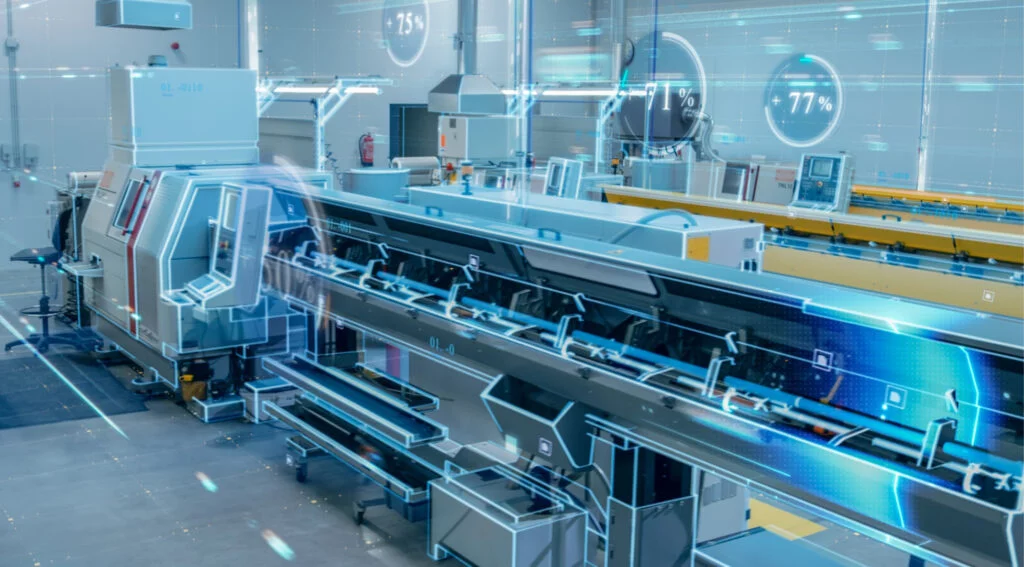
At Dillygence, our digital twin DispoX excels in optimizing production flows, surpassing classical approaches with a speed of analysis thousands of times greater and consequently its ability to analyze the dynamics of the factory as a whole. We thus position ourselves as a key player in digital twins based on AI dedicated to optimizing industrial performance.
As AI and LLM technologies tend to become commodities, our strength lies in our R&D and the way we use business expertise in combination with AI and LLMs. This allows us to perform surgical, rapid interventions that generate impactful results, often amounting to millions in gains for our clients. Our logistics projects, whether in production management, logistics planning, or supply optimization, rely on advanced engineering, strong agility, and continuous improvement in flow management.
To go further
Gartner Hype Cycle for AI of June 2025:
Kinaxis:
Planisense-Futurmaster:
SAP:
*SQL = Structured Query Language it is the universal language used to query relational databases, and all ERPs rely on relational database management systems.
* For decades, it was the term forecasting that I used, today the term prediction is dominating, driven by data scientists whether in French or English (forecast – prediction). It is time to clarify these nearly synonymous terms, as both consist of an estimation of the future :
Forecasting is an estimation of the future based on explicit models, historical data, and a certain understanding of causes,
Prediction is an estimation of the future without necessarily understanding the mechanisms, often based on algorithms or statistical correlations as Chatgpt tells me. Indeed, with AI solutions, for example Deep Learning or Random Forest, models learn complex and nonlinear relationships in data, but do not always make visible the correlations they use. While in general, and paradoxically, prediction can prove more accurate than forecasting, it remains that correlation may reveal causation but, in reality, provides no guarantee... thus, errors can occur due to this assimilation by AI between correlation and causation.